insight
Payday Super Readiness Guide for Australian Businesses
Ready to streamline the way you run payroll?
If you run a business in Australia, one of the most important things you need to get right is your superannuation obligations. Payday Super readiness means you’re all set to calculate, report, and pay your employees’ super contributions correctly and on time — every payday. This guide will walk you through everything you need to know, step-by-step, so you can avoid penalties.
Table of Contents
- What is the Superannuation Guarantee (SG)?
- Getting Set Up for Payday Super Readiness
- How to Calculate Super Contributions
- What is the Payday Super payment deadline?
- Reporting Super Contributions with Single Touch Payroll (STP)
- Keeping Records and Staying Compliant
- Handy Tips for Payday Super Readiness
What is the Superannuation Guarantee (SG)?
Think of the Superannuation Guarantee as a compulsory savings plan for your employees’ retirement. As an employer, you’re legally required to put a percentage of your employees’ earnings into their super fund.
- Current SG rate: 12%
- Who it applies to: Most employees aged 18. There are some exceptions, like certain contractors or very young workers.
The SG rate is set by the Australian Federal Government and can change, so it’s good to keep an eye on updates.
Getting Set Up for Payday Super Readiness
a. Register Your Business Properly
Before you can pay super, make sure your business is registered with the Australian Taxation Office (ATO) and has an Australian Business Number (ABN). You’ll also need to be registered for Pay As You Go (PAYG) withholding if you have employees.
b. Pick the Right Super Fund(s)
Your employees can choose their own super fund, or if they don’t, you’ll need to pay into a Stapled fund or in the absence of this, a company default fund. The default fund must be a complying fund registered with the ATO.
If you’re unsure which fund to use, the ATO has a list of default funds you can choose from.
c. Collect Employee Super Details
Make sure you get your employees’ Tax File Numbers (TFNs) and super fund details early on. This helps avoid delays or mistakes when paying super.
d. Set Up Your Payroll System
Use payroll software that can calculate super contributions automatically. This reduces errors and saves you time. Australian payroll systems now integrate with Single Touch Payroll (STP), which reports super payments directly to the ATO. From 1 July 2026, payroll systems are required to integrate Payday Super to calculates and reports super automatically.
How to Calculate Super Contributions
What Counts as Ordinary Time Earnings (OTE)?
OTE is the amount you use to calculate super. It includes:
- Salary and wages
- Commissions
- Shift loadings
- Allowances
- Bonuses (if related to ordinary hours)
OTE does not usually include overtime payments unless they are part of the employee’s ordinary hours.
Why It Matters
Getting this right is crucial because underpaying super can lead to penalties and back payments. For additional assistance, review the ATO superannuation calculator.
What is the Payday Super payment deadline?
From 1 July 2026 your organisation must pay your employees super guarantee on payday, at the same time as their salary and wages and must be received by the Super fund within 7 business days and be able to be allocated.
Reporting Super Contributions with Single Touch Payroll (STP)
STP changed the game for employers and Payday Super reporting will benefit from this framework. STP reporting lets you report superable wages (known as Qualifying Earning) and super contributions to the ATO in real time, every payday.
Benefits of STP
- Simplifies reporting
- Reduces paperwork
- Helps employees track their super contributions through their myGov account
Keeping Records and Staying Compliant
What to Keep
- Employee super fund details
- Payment records
- Payroll reports
- STP reports
Keep these for at least 5 years in case the ATO needs to review them.
What if You Miss a Payment?
If you don’t pay super on time, you may have to pay the Super Guarantee Charge (SGC), which includes the unpaid super, interest, and an administration fee. The ATO can also impose penalties.
If you find yourself behind, lodge a Superannuation Guarantee Charge Statement with the ATO and pay the outstanding amounts ASAP.
Source: ATO - Super guarantee charge
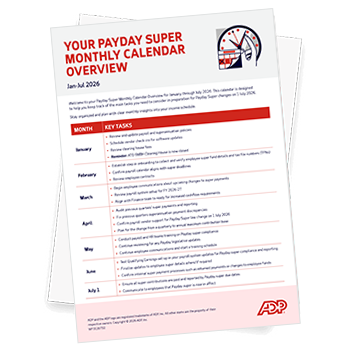
Monthly Payday Super Calendar Overview
Handy Tips for Payday Super Readiness
- Automate everything: Use payroll software that calculates, reports and pays super automatically.
- Double-check employee details: Incorrect fund details can delay payments and potentially result in penalties.
- Communicate with your team: Let employees know when super is paid and how it’s calculated.
- Stay informed: Super laws can change, so keep an eye on ATO updates.
- Plan cash flow: Budget for more frequent super payments so you’re never caught short.
Additional Resources
- Australian Taxation Office (ATO) Superannuation for Employers: https://www.ato.gov.au/Business/Super-for-employers/
- Fair Work Ombudsman — Superannuation: https://www.fairwork.gov.au/pay-and-wages/tax-and-superannuation
- Australian Securities and Investments Commission (ASIC) — Superannuation: https://asic.gov.au/for-consumers/superannuation/